
What Temple Cave actually is
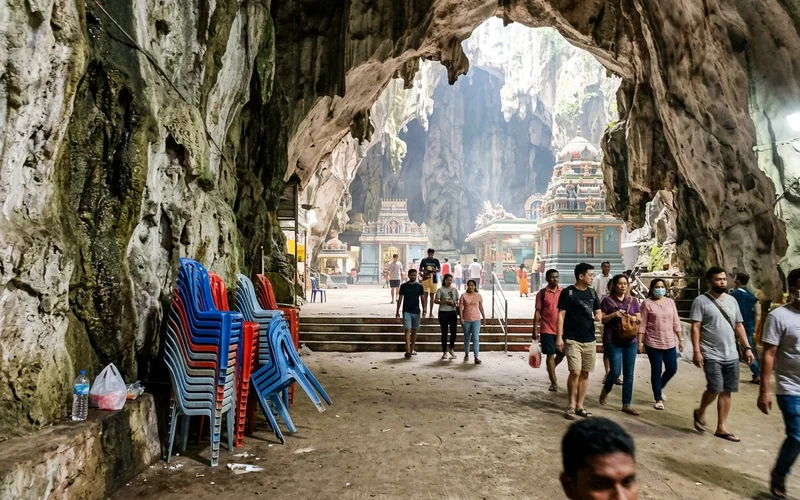
Temple Cave, sometimes called Cathedral Cave, is the main draw at Batu Caves and the reason the site exists as a place of pilgrimage. It is a huge limestone chamber inside a 400-million-year-old karst hill in Gombak, about 13 km north of Kuala Lumpur, and it holds working Hindu shrines dedicated to Lord Murugan. The ceiling opens in places, so daylight drops in shafts onto the shrines below.
Two things surprise first-time visitors. The first is that it costs nothing. Entry to Temple Cave is free, and it is open 6:00 AM to 9:00 PM every day. The second is that it is not a museum. People come here to worship, every day of the year, and the tour groups move through the middle of that.
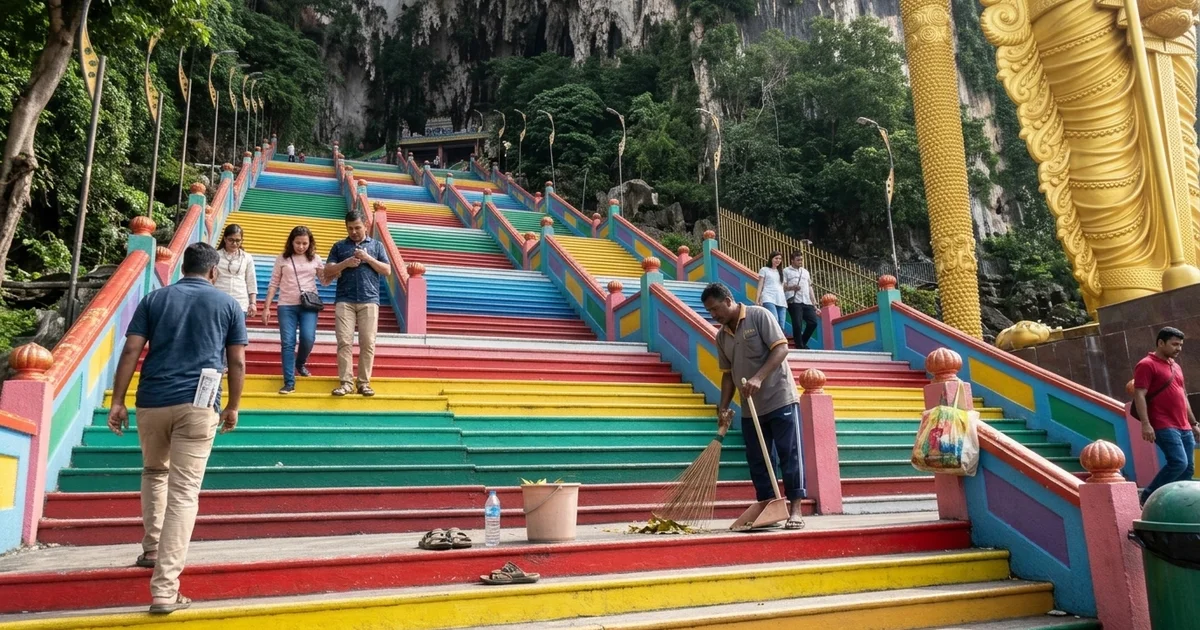
Getting there is a staircase: 272 steps, repainted in bands of colour a few years ago, which is why every photograph you have seen of Batu Caves looks like a rainbow running up a cliff. The 42.7 metre gold statue of Lord Murugan stands at the bottom, and most people photograph the two together. If you want the temple explained rather than just photographed, that is what our guided Batu Caves tour is for: a licensed guide who can tell you what the shrines are, what the Vel means, and where not to point a camera.
The one rule that catches people out
Shoulders and knees covered, for men and women, enforced more strictly for women. Sarong rental is RM 10-15 at the entrance if you arrive underdressed, but it is easier to dress for it than to queue for one.
When to go, and when to photograph
The staircase faces roughly east, which is good news for morning visitors. Weekday mornings before 9:00 AM give you softer light on the coloured steps and a fraction of the crowd. The busiest window is 10:00 AM to 4:00 PM, when tour coaches stack up in the forecourt and the stairs turn into a slow-moving queue.
If you want the statue and the full staircase in one frame, back off toward the forecourt rather than shooting from the base. From the bottom step the perspective compresses and the stairs look shorter than they are, which is also why so many people underestimate the climb.
| What you want | When to go | Why |
|---|---|---|
| Empty-ish stairs for photos | Weekday, before 9:00 AM | Softer light, no coach groups yet |
| A calm visit inside the cave | Weekday morning | Fewer people in the shrine areas |
| Evening light on the statue | Late afternoon, before 8:30 PM | Warm light, but busier and hotter |
Rain changes things. The steps are painted concrete and get slick, and the handrail becomes genuinely useful rather than decorative.
The monkeys, honestly
Long-tailed macaques live on and around the staircase. They are wild, habituated to people, and extremely fast. They are not looking to hurt you, they are looking for food, and they read a plastic bag, an open backpack pocket or a water bottle in your hand as an invitation.
The practical advice is short. Do not feed them, do not carry visible food or drink, close your bag, and keep children within arm’s reach. If one takes an interest, do not tug back on whatever it has grabbed. Let it go.
Before you climb
There is no lift, no ramp and no alternative route to Temple Cave. It is 272 steps, they are steep, and there are landings where you can stop and let your legs recover. Most reasonably mobile people manage it by taking it slowly. If you are travelling with older relatives or anyone with knee, hip or heart issues, read whether you can manage the 272 steps before committing to a plan.
If you are on a short Kuala Lumpur trip and would rather have the logistics, the temple context and the pacing handled for you, a guided half-day covers all three. If you have a free morning, are comfortable on public transport, and mainly want the photographs, the train from KL Sentral costs RM 2.60 and puts you at a terminus facing the entrance. Both are honest answers.
What is at the top
The chamber itself is large enough that the scale takes a moment to register. The ceiling rises well over a hundred metres in places and opens in gaps that drop columns of daylight onto the floor, which is why photographs taken from inside almost always look better than the ones taken on the way up.
The shrines are the point. Sri Subramaniar Swamy Devasthanam sits at the far end, and there are smaller shrines along the route. People are praying at them, priests are working, and offerings are being made, all of it on an ordinary Tuesday as much as at a festival. Move quietly, do not walk between a worshipper and a shrine, and keep camera shutters and voices down near the altars.
Swifts and bats live in the roof, so there is constant movement and noise overhead. The floor is uneven and damp in places. Sensible shoes matter as much at the top as on the climb.
How long to allow
From the forecourt to the top and back, with time to look around properly, most visitors need 60 to 90 minutes. The climb alone takes 10 minutes at pace or 25 to 30 taken slowly with rests.
Add the ticketed caves at the base and you are into a solid half-day on site, before travel from central Kuala Lumpur. Working backwards from a 9:00 AM arrival is the plan that goes wrong least often.