
Start with the staircase question
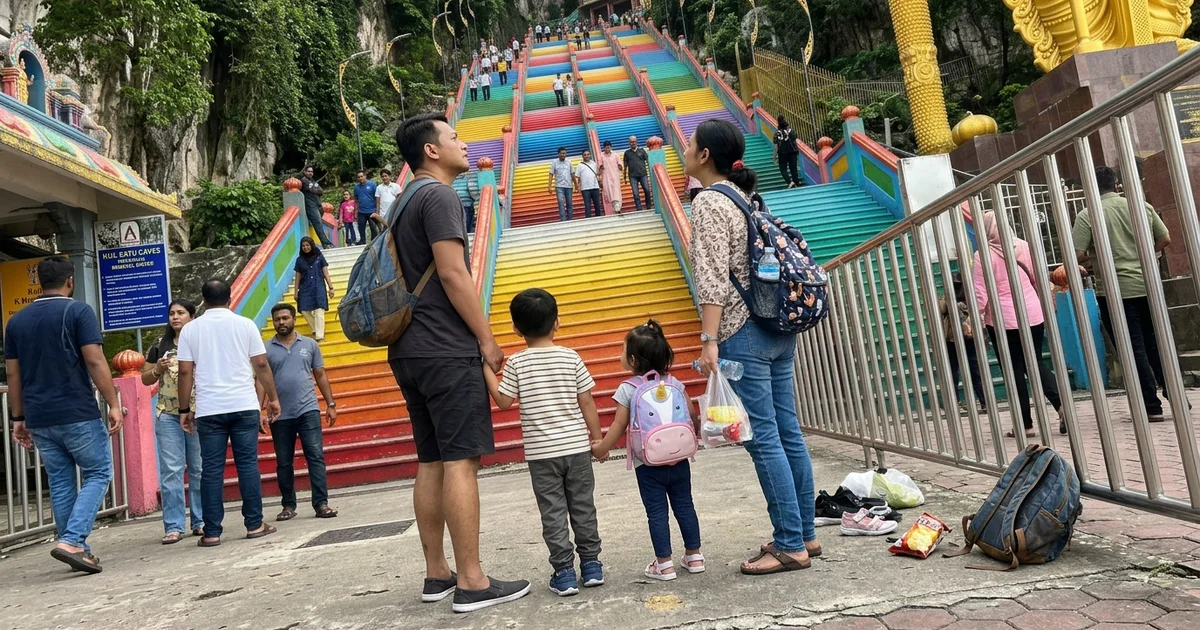
Batu Caves works well with children. It is free, it is visually spectacular, there are monkeys, and it is genuinely different from anything most families have at home. The planning all comes back to one thing, though: 272 steps, no lift, no ramp, no alternative route.
A stroller cannot go up. That is not a rule someone might bend for you, it is a staircase. Strollers are fine in the forecourt, around the Murugan statue and at the ground-level caves, but the climb needs to be done on foot or in a carrier.
Practically, families tend to do one of three things. Carry the smallest child in a back or front carrier, which works but is warm and tiring in the humidity. Split the group, with one adult staying at the base with the stroller and the youngest while the others climb, then swapping. Or, with children who walk confidently, take the steps very slowly with plenty of stops at the landings.
Children over about five who are used to walking usually manage the climb fine, and often faster than their parents. If the logistics are the part putting you off, hotel pickup on our guided Batu Caves tour removes most of them. The physical side of the climb is covered in more depth in whether the 272 steps suit your family.
The one thing worth booking around
Heat, not steps. A 7:30 AM climb with children and a 12:30 PM climb with the same children are completely different experiences.
Timing makes or breaks it
Go on a weekday morning before 9:00 AM. This is the single most useful piece of advice on this page.
Before 9:00, the air is cooler, the staircase moves freely, and the Temple Cave at the top is calm enough for children to look around properly. From 10:00 AM to 4:00 PM the coach groups arrive, the forecourt fills, and the steps turn into a queue in full sun. With a tired four-year-old, that is a very different morning.
| Before 9:00 AM (weekday) | 10:00 AM - 4:00 PM | |
|---|---|---|
| Temperature | Manageable | Hot and humid |
| Crowds | Light | Heaviest |
| Climb | Steady, at your pace | Slow queue on the steps |
| Photos | Soft light, clear frames | Harsh light, people everywhere |
The monkeys, with children
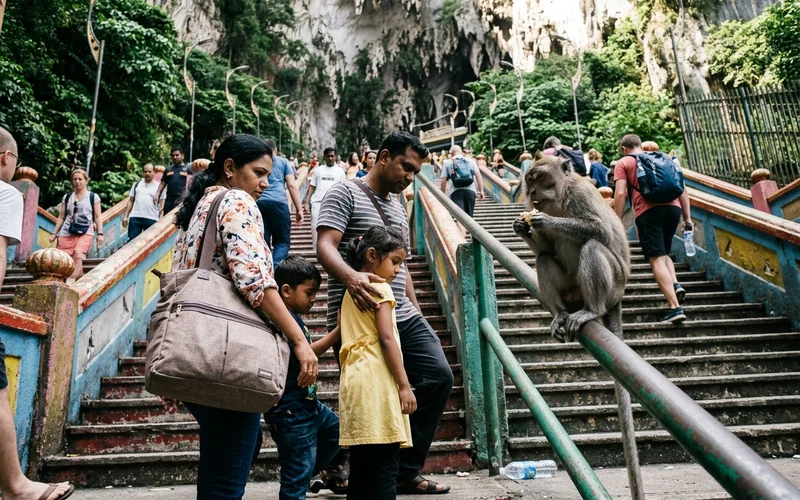
Long-tailed macaques live on the staircase and around the forecourt. They are wild animals, not an attraction, and they are quick.
They are also the thing children most want to get close to, which is where the trouble starts. The rules are simple and worth saying out loud to your kids before you arrive: no visible food or drink, bags closed and held in front, no reaching out, no feeding, and hold hands on the staircase. If a monkey grabs a water bottle or a snack, let it go. Nothing you are carrying is worth a bite.
Older children usually enjoy the monkeys enormously from a sensible distance. Toddlers, who move unpredictably and often have food, need an adult within arm’s reach the whole way up.
What to bring, and what to wear
Water for everyone, more than you think. Sun cover: hat, sunscreen, and a shirt with sleeves. Shoes with grip, never flip-flops, for children who are climbing themselves.
Dress code applies to children as well as adults: shoulders and knees covered. Sarong rental is RM 10-15 at the entrance if you get caught out, but it is easier to leave the hotel dressed for a temple.
Also worth knowing: Ramayana Cave (RM 15) and Cave Villa (RM 15, RM 7 with MyKad) are both at ground level. If half your group is staying at the base, those give them something to do rather than sitting on a wall.
Keeping children interested
Batu Caves is not a museum with activity sheets. What holds children’s attention is the scale and the strangeness: a gold statue the height of a fourteen-storey building, a staircase painted in stripes, monkeys everywhere, and a cave with a hole in the roof that daylight drops through.
A few things that reliably work. Count the steps out loud in blocks of fifty, so the climb has milestones rather than being one long slog. Point out the macaques from a distance and give the children the job of spotting them, which also keeps them alert to where the monkeys actually are. Inside the cave, the shafts of light and the birds overhead usually do the work by themselves.
Older children often engage with the story if someone tells it properly: who Murugan is, why the spear matters, why people are climbing barefoot. That is a real argument for a guide with a family, more than with adults travelling alone.
Where a tour helps with a family
The honest case for booking is not access, because Temple Cave is free. It is that hotel pickup removes the hardest part of the day with young children: getting to KL Sentral, onto a 30-40 minute train and back again, in the heat, with a bag of snacks and someone who needs the toilet.
A guided half-day collects you from your hotel within 10 km of the Petronas Twin Towers, goes at your family’s pace, and puts a guide alongside you who can explain the temple in terms a curious eight-year-old will actually listen to. It also means a vehicle to retreat to when somebody has had enough, which on a hot morning is worth more than it sounds.
If your family travels easily on public transport and the children are old enough to enjoy the train as part of the adventure, the KTM is RM 2.60 and a perfectly good option. Both answers are fine, and we would rather you picked the one that fits your family than the one that fits our booking sheet.